Bloglovin' Facebook Pinterest E-Mail Instagram Shop Home About Us Freebies Shop Image Map

Sunday, October 18, 2015

Student Choice with Writing Menus


Writing.

Some people hate it, others love it.  Over the years, I’ve found that the students who dislike writing do so because they don’t have enough options.

When I work on writing with my sixth graders, I like to give them as much choice as possible. Because of that, I use something called a writing menu. At the beginning of every other month I give the kids a menu with 12-16 writing choices. The assignments are designated as appetizers, entrees, and desserts.

Appetizers are quick writing assignments, things that can be fully answers in 1-3 paragraphs. Entrees are your standard 5 paragraph essay and are graded as summative assessments.  They are required to complete a pre-write, first draft, peer review sheet, and final draft for all entrees. They need to complete 3 of the 4 choices. Entrees are really the “meat and potatoes” (Ha!)  They are designed to be detailed and to make the kids think a little deeper. I always link it to whatever novel we are reading in literature.  The “dessert” assignments tend to be more fun. They are either super creative or involve technology in some way. ( We are a 1:1 iPad classroom)
In total, at the end of the month, the kids must complete 9 of the options with three of them being entrees.  We only use a writing menu every OTHER month because in the “off months”, after some feedback, we spend time making our writing stronger and working on revisions.   
I’m fortunate to be able to have the time to work in small literacy groups and conference with the kiddos each week, otherwise I think I would adjust the procedure a bit. We also spend a lot of time giving each other feedback on our writing.  At the end of the month, we have portfolios with 9 writing samples for each student.
We keep ALL writing that we do in binders for the year.  I have found that it’s important for the students to see how they have grown from August to June, especially the reluctant writers.
I love hearing the discussions the kids have about what they’re working on during literacy group time.  I love hearing them give each other feedback on traits such as organization and sentence fluency. 
Writing menus aren’t for the faint of heart now. Keeping track of 207 writing assignments and individual student growth ( which is why we keep all drafts)  takes some organization skills.  This is why it is very helpful to conference weekly with students because really, by the end of the month, I already have a very good idea of what they’ve written.

The writing menus I use are tailored to things we’re talking about in class, but you are welcome to see a copy of what we worked on in September here. September Writing Menu  as well as a copy of the writing rubric that I use most often Writing Rubric


Friday, October 16, 2015

How to get students ENGAGED in Descriptive Writing!

In sixth grade in my curriculum, we learn about descriptive writing during our second unit of study. Descriptive writing is one certain students love and certain students hate. I have found that some of my students struggle just to write a basic sentence and an essay is too much to start off with. We work through many mini lessons with descriptive writing that I have found from some amazing bloggers throughout our teacher blogger world.

My first descriptive writing activity I always do is the descriptive writing monster. This activity is perfect for this time of year as well. I bought this activity with a $1 deal on TPT and it still is. You can view this product here. The students FIRST draw their monster and then describe each body part. After they are done with their descriptions, they then write a descriptive paragraph based on their picture and graphic organizer with the body part descriptions. This helps the students because they first drew a picture so it is a lot easier to describe something they are looking at directly. After the whole class is done, I have the kids all hang up their monsters and then I read the paragraphs one at a time and the students try to guess which monster is which. This really teaches them that they must be descriptive in their writing. It also allows them to have more examples of descriptive paragraphs.

The next descriptive writing activity that I love is one that really makes students think deeper. This is from Miss Radka's Rhapsody. Students use an emotion and first draw a picture of that emotion. I told my students specifically no people in the photo so they had to use colors, symbols, etc. After this point they wrote a paragraph describing the emotion--talk about making them think on a higher-level!

The last descriptive writing activity that I use to introduce descriptive writing is a POPCORN! descriptive writing activity. Even thought this is first grade TPT, I just used this graphic organizer with the five senses because I thought it was cute :) I popped the popcorn and went through the five senses and described each one. We then wrote a descriptive paragraph about the popcorn.

I hope these activities help you with descriptive writing with your students too! They have really work wonders with mine!


Thursday, October 15, 2015

Luck of the Draw - Using Creative Writing to Understand Genre

Hello! Susie here from Anchored in Reading ready to talk about writing and genre. When I first started teaching years ago, I am embarrassed to say, I never really provided opportunities for application. I would teach a lesson, provide some type of practice, and finish the lesson with some form of assessment. At that time I taught Learning Support Reading and Math. Things were moving along smoothly, but we weren't really learning a whole lot. It took me a couple of months to realize why we weren’t making progress, but the light bulb finally went off. Application.  I needed to give an opportunity for application. In many cases, especially with struggling students, a quick practice is not enough for true learning. Since then, I find myself creating opportunities for students to apply the new material they are learning. This can sometimes prove challenging, but very beneficial!  (Yes, I realize this is obvious now, but it certainly wasn’t then! I had many ‘duh’ moments when I first started teaching!)


The same goes for teaching genre to middle school students. I start my lesson with a PowerPoint.  Students take notes in their interactive notebooks (IRNs - see pictures below) as I discuss important characteristics of each genre. We talk about books we are currently reading, or have read, and the type of genre for each book. We look at the books in our classroom library and try to identify the genre of a few. I continue my lesson by reading excerpts from books and ask my students to identify the genre of the passage I am reading. 


By this point, I have saturated my students with information about genre. They are really starting to develop an awareness of what genre is. To give thorough instruction on genre, however, I can't stop there. The final part of the lesson, the application part of the lesson, always proves to be my fave! In a bowl (very high-tech) I have multiple slips of paper folded with a specific genre on it. Each student pulls one slip of paper and writes the genre they pulled on the top of their paper. I tell them they are NOT to tell anyone around them which genre they pulled.  


I then instruct my students to write a paragraph or two in the genre they pulled. This writing should be creative and will be shared with the class. I tell my students not to worry too much about spelling or producing a fabulous 5-paragraph essay. Just write.  For some reason, my students, even the group of kiddos who do not like to write, love this activity! Perhaps, it's the freedom they feel writing the way they want to write.  The anticipation of which genre they are going to pull adds to the excitement.  Before my students start writing, I share my example with them and we dissect my paragraph to determine the genre. Then, my little birds take off! 


After about twenty minutes of writing (sometimes longer, we usually need to continue the next day) we share our writing with the class. As a class, we have to determine the genre type of each students’ writing.  Almost all of my students want to share their writing and they all like trying to guess the genre. 


Application. I finally have application. 


Wednesday, October 14, 2015

Student Writing Folders


Hi Everyone!

Caitlin from Teach Inspire Change here :)

I wanted to briefly share with you how and why I chose to use Student Writing Folders in my classroom. 

Let's be honest. As English teachers, we can spend upwards of 15+ hours of grading student essays. EASILY. We leave them awesome feedback, helpful tips for improvement and so much much! You hand them back to students, they look at their grade, and then what happens? You find that essay that you poured your heart and soul into grading (and gave you wrinkles when the student confused "their," "there," and "they're") in the garbage can! Ummm. NO. 

So I decided my students were going to save every. single. essay. that they wrote and that I graded throughout the year. So I put together these cute student essay folders. 

Concept is simple: They write. You grade. They file. And you keep 'em in your classroom! 

I wrote each of my kids a note describing what our Student Writing Folders are all about. This sits in the front of each of their folders. 
I bought these folders at Target for $0.10 each before school started - GREAT deal! I also decorated each folder with washi tape :)
The little folder filer that I bought. To save space, I put two students folders in each tab. To keep it easily organized, I just had my kids use their class numbers (that way I could use this for years to come!). 

It's actually really fun, too, for your kiddos to go back through their essays at the end of each month to see how much they really have improved. 

How do you make sure your essay comments don't end up in the trash can? Please share in the comments below! 


Monday, October 12, 2015

Literacy and Mathematics

Hi, everyone! Mandy from Caffeine and Lesson Plans here to talk to you about writing in mathematics. It's something that has been on my mind a lot lately, as my district has designated writing as the focus of our instruction for this school year. So many teachers automatically began to focus on narrative writing, but I thought I'd apply it to my teaching in other ways, too- namely, in mathematics!


I have to tell you, math has a special place in my heart. In addition to my generalist teaching license, I hold a math specialist license. I think that people tend to give themselves permission to be afraid of math in a way that they do not in other subjects. I've heard parents dismiss a student's bad grade by saying "oh, well, I was never good at math either. Maybe he doesn't have a math brain" I've never heard a parent say the same about another subject though. No one dismisses poor reading with "well, maybe he doesn't having a reading brain." All the parents I have worked with have done everything possible to help their child overcome their reading difficulties, and when all else fails they have had them tested for learning disabilities. So, why the difference in math? I think it all comes down to how students are taught. Allowing students to apply the academic skills that they are good at and enjoy using will help them to deepen their mathematical knowledge. Sounds easier than it is, right? I totally agree- and there are a million ways to incorporate literacy and mathematics! They don't all work for the middle grades, either. So- here are my quick tips.

Math Literature
Invest in some quality mathematical literature. It's expensive, but there are ways to get some reasonably priced books. I visit my local used bookstore, go to library book sales, and hit up yard sales. I also order them from half.com and check the used prices on amazon.com. When all else fails, I use my scholastic book points to order them. My math library is well stocked- I have something for everyone! I have created task cards to go with each math literature book, and have my students read them during one station of guided math. It's a win for everyone. My students that are avid readers can't wait for the opportunity to read some more, and my struggling readers get the opportunity to practice their reading some more. More than that, teaching mathematics through literature makes a stronger connection to the material. The students see it is a something that is learned organically, much like the morals or lessons that they learn from other stories that they read.

Creative Writing
 I mentioned earlier that my focus on writing this year has tied into my mathematics instruction. So far, it has really worked. Each morning as my "do now" activity I give my students an equation that relates to what we learned the previous day. Their job is to write the story of the problem. They write a word problem that ranges between a few sentences and a paragraph. I have seen some seriously creative writing come out of this! More than that, their stories have given me some really good insight into their mathematical understanding. Do they know the key words that indicate operations? Do they correctly describe which operation to use within their story? Do they understand  how to indicate what each number represents? I feel as though I have been able to learn more about what the students actually understand by reading their stories than by checking their computations on word problems I provided.

Expository Writing
Some of my students really need to talk about their learning to help build permanent knowledge. Usually, this isn't a problem in my classroom as we work in small groups and talk frequently throughout the lesson. Sometimes, though, we just don't have enough time to talk as much as I would like. So, I ask my students to "talk it out" in writing like they would with a partner. I often have them write a letter to another student explaining how a particular mathematical concept works- for instance, how to create equivalent fractions. I always ask them to pretend the person they are writing to has no mathematical knowledge so they explain everything.  The act of putting the words on paper makes deep connections that some students need.

So, that's it- how I incorporate literacy and mathematics instruction in my classroom. I'd love to hear what's worked for you, too!


Friday, October 9, 2015

Tips for Teaching Realistic Fiction


Shana from Hello, Teacher Lady here.

My 7th graders are currently in the midst of one of my favorite units, Realistic Fiction. It's so much fun to see their creative sides and I'm always impressed with the ideas they come up with. So for today's post, I'd like to share with you some things I've learned about teaching this wonderful genre!

  • Define the genre: This sounds like a no-brainer, but in the past I've jumped right into the unit without clearly defining and consistently reinforcing what realistic fiction is... and what it isn't! As a result I've had students come up with some brilliant story ideas, only they fit into other genres such as science fiction or fantasy. Now I make sure to provide students with plenty of mentor texts to serve as examples and we talk about realistic fiction elements on a daily basis. I might sound like a broken record sometimes, but I don't have to crush as many students' dreams about robot rebellions or magic kingdoms.
  • Brainstorm, plan, share and repeat: It's important to give students plenty of time to brainstorm, plan and share their ideas with others. We spend about a week in the brainstorming and planning stages before students even begin to draft their scenes. They need to have a firm grasp on who their character is and what their conflict/resolution might be, so we spend a couple days solely focused on discovering their characters' motivations and struggles, and a couple days solely on brainstorming potential internal and external conflicts. 

For help with internal/external conflict, I like to show short Disney clips on YouTube and have students discuss the various types of conflicts they notice. "One Jump Ahead" from Aladdin is always a class favorite!


  • Write with them: One of my favorite parts about this unit is actually writing my own realistic fiction story too! I always try to model the thinking process during the brainstorming phase or demonstrate anything that I’m asking my students to do, so writing my own story just sort of naturally happens over the course of the unit. I think it’s beneficial for students to see this progression, and they always have fun brainstorming ideas with me!
  • Collect graphic organizers and exit slips. My district follows the Workshop model, so they have a lot of class time to brainstorm and plan while I circle the room (in an attempt) to "confer" with every student. This is an area of workshop I admittedly still struggle with, as I find it difficult to touch base in a meaningful way with every student. While I’ve always given them graphic organizers to complete before they begin drafting, and I’ve attempted to read through them during our mini-conferences, the fact is there’s just not enough class time for this! To help save time, I started collecting students’ graphic organizers and making comments at home, then using my comments to help guide my conferences during class. This really helps me see if students are on the right track before they get too far in the writing process, and I'm able to identify common problems and can pull certain students for "strategy groups" if I notice a pattern. It’s a little more work at home, but it saves tons of class time and makes conferring so much easier and more efficient! For exit slips, sticky notes are a great tool, and you can display them in your room as visual proof of your students’ thinking and progress!
  • Set a page limit! This one is for your own sanity. I tell my students they have to tell their stories in 5 pages or less. If you don't set a page limit, you'll end up getting some reeeeallly long stories... 

Thanks for stopping by the blog today! I hope you found this helpful! :)


Thursday, October 8, 2015

How I Help Struggling Writers


If you have students with special needs in your general education class or just have some students who are slow learners that struggle with writing, then this post is for you!

I have been teaching ELA and SPED at the middle school level for nearly 22 years.  It has been my experience that to reach the students that struggle and have those moments where the light bulb comes on with writing is to embrace patterns.

Let me show you what I mean:


These are my text-based essay anchor charts that I have used with both "regular" and special needs students.  These anchor charts provide a pattern for students to follow along with a memorable mnemonic.  

HAT is for the introduction - a hat goes on top of your head and likewise goes on "top" of the essay.  ACE IT is a good way to remember what goes in the body of an informative essay and ARGUE matches argumentative.  Then what's the last thing you grab before your leave home?  Your cell phone - your AT & T!  Ok, I know not everyone has AT & T but work with me here!  :)

Now keep in mind that this is just a foundation.  I am not suggesting that these structures completely define an essay.  Certainly as the students learn more and progress, so will their writing.  

However, for students who are really struggling, this gives them a lifeline.  I have found that most students "get" the concept of an essay and maybe even know some of the basic vocabulary, but they lack an understanding of how to apply what they know.  It all seems theoretical without a pattern to follow.  It's like me understanding that I need to go north to reach my grandmother's house but not being able to get there without a map.

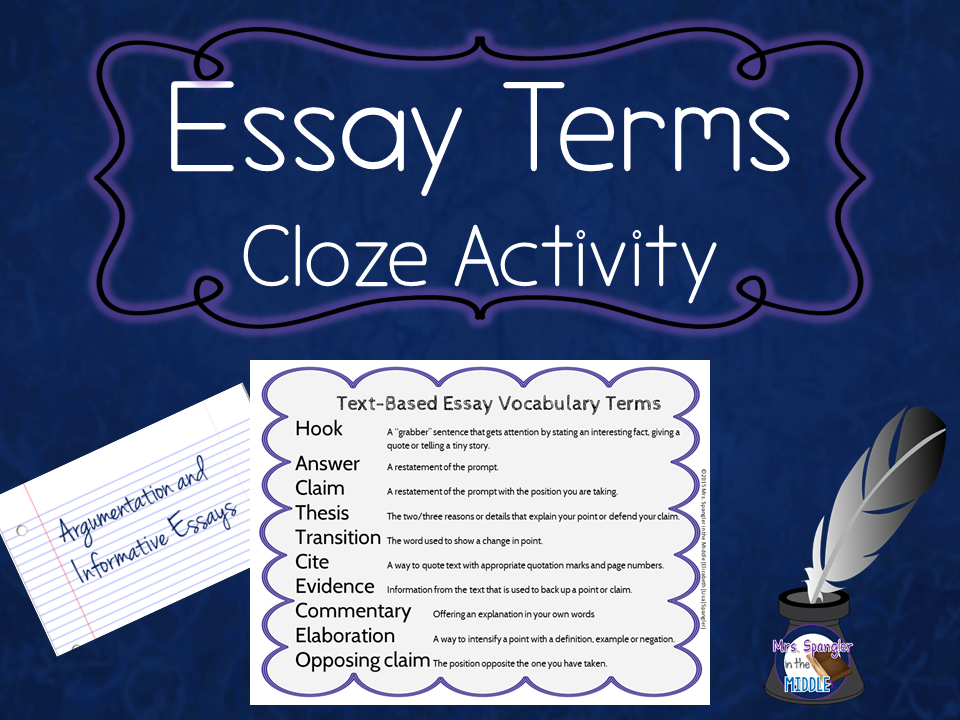
So first we go over all the vocabulary.   There are so many ways to do this but one of my favorites is using Quizlet.  This is a free site and app where you input the words and definitions and then the program places your information into various games.  Then, when you're ready to assess, you can use my free 


Next,  I take the students through the entire process of essay writing:

-reading the prompt
-understanding what they are reading to find out
-reading the texts one at a time & then mapping them one at a time
-planning the essay according to the pattern with a graphic organizer
-modeling each paragraph type with a foldable


Yes, this takes time (about 7 days or so), but it is so totally worth it when you see your students go into the tests with a plan and then watch them implement that plan on their planning sheets!  That means no more blank planning sheets!!  Can I get a Hallelujah?! That's what I was shouting inside my head last year when I saw this happen with my own eyes for both my "regular" and special needs students.

If you'd like more information on how to implement the step-by-step Informative Essay or Argumentative Essay, please click on those titles.

Want to share your experiences with struggling writers?
Join in the conversation in the comments below!