Bloglovin' Facebook Pinterest E-Mail Instagram Shop Home About Us Freebies Shop Image Map
Showing posts with label standardized testing. Show all posts

Sunday, March 26, 2017

Top 3 Test Prep Ideas


Top 3 Test Prep Ideas from the Middle School Mob!

We have two weeks after Spring Break before our State Testing begins.  That means we have two weeks to drive those final concepts home.  How might we do that without the drill and kill?  Well,  here's my top 3 ideas:

1.  Start with vocabulary
Academic vocabulary is comprised of the words that are most often used in informational texts (such as textbooks) and literary texts (such as novels), but not likely used in everyday speech.  This is the vocabulary that our students will find embedded in test passages and test questions.  That means that this vocabulary has to be explicitly taught.  What I did is recorded here:   http://middleschoolmob.blogspot.com/2016/03/the-secret-to-top-scores-on-state-tests.html   It involved me going through my state's test item specifications and pulling out the key vocabulary and then making games to help students learn the words.  Which brings me to #2...

2.  Use games.
May I suggest Kahoot?  It's a FREE, online quiz game.  Students love it and it is super easy to input test questions from your state's practice tests.  You could also make much more low-tech games like Tic-Tac-Toe.   Here's how I have used this game:

1.Divide the class into two teams.  One is the “x” team and one is the “o” team.
2.Draw a tic-tac-toe board on the whiteboard.
3.Ask a question to the first member of the “x” team. If he/she is correct, then he/she places the x on the board!  If he/she is incorrect, he/she simply lose the chance to place the “x” on the board.
4.Now repeat #3 with the “o” team. 
5.Continue with each member of each team until you have a winner with 3 in a row!  You might even give bonus points as a prize!


3.  Use centers.
Even big, bad middle schoolers like centers.  I would suggest that you look at your data, pinpoint the areas of need, and then set up centers or ahem, stations, around your room. Here's a list of possible activities for centers:

1.  Playing skill specific games on quia.com
2.  Reading a picture book and then drawing the main idea.
3.  Completing a cause/effect graphic organizer on a picture book.
4.  Making a poster of text features based on a non-fiction text.
5.  Making a foldable for a picture book that uses compare/contrast.

I have done this type of thing without setting up formal centers but instead using a menu. I used the picture book Miss Rumphius because of its great message for students.


Have you ever tried using menus for test prep?
Click here or on the image above to be taken to this great freebie!


If you'd like to read more about Test Prep, stop by my blog for my latest installment on a reading "boot camp" my fellow teachers and I are conducting by clicking here:

http://mrsspanglerinthemiddle.blogspot.com/2017/03/test-prep-reading-boot-camp.html

Thanks for stopping by!


Monday, May 9, 2016

GO Paperless Test Review

Hey all!  This is Lyndsey from Lit with Lyns, and I'm going to share how I prepare for state testing without making the dreadful copies.  Our district is currently out on spring break (yay!).  Once we go back to school, we only have a week before testing begins.  Before the break started, I was trying to plan for how my students would review and decided that this year, we were going to do it online.  At my school, we use Google Classroom, but there are many programs that can be used if you don't have this (Edmodo, Canvas, Schoology, etc.).

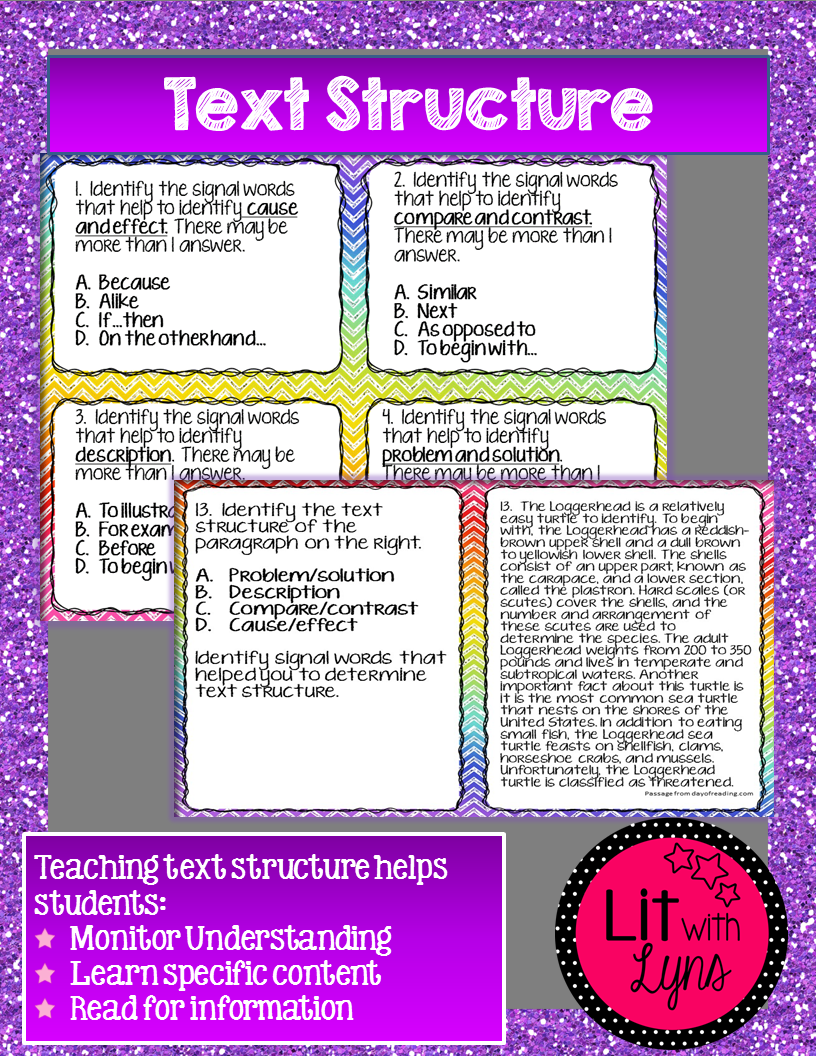
There were several areas I want to review with my ELA students, so I decided I would use task cards that cover the following:  main idea, story elements, figurative language, point of view, and certain areas of grammar.  In order to ensure that each student gets an adequate opportunity to cover each of these areas, I'm going to put the kids in groups.  Within their groups, they will "virtually rotate" through stations (they won't physically rotate, but once their group completes the activity/station, then they will move on to the next activity/station).  I uploaded each activity to Google Slides (which you can do too, if you create a Google account).  Once I have created each group activity, I will "share" it with the students by clicking on the blue "share" button at the top, right side of the screen.  Again, if you use other programs, such as Edmodo, you can do the same sort of practice.

I have also created a similar activity for the Google Drive that I recently posted on Teachers Pay Teachers.  My ELA Test Prep Task Cards for Google Drive can be found here.  See a preview of this below:


I would love to hear what you're doing to get your students ready for the end of year testing!  Please share in the comments!

Wednesday, March 23, 2016

Creativity in Action: Test Prep without the Boredom

It's me, Michele from A Lesson Plan for Teachers, and I'm here to make a few suggestions that are near and dear to my heart for test prep season! 

In my classroom, creativity has always been welcome, encouraged, and appreciated.  Based on the research I studied on gender gaps in the classroom back in the 90s, all students and especially females retain content more successfully when given the opportunity to process that content creatively.  So why, when it comes time to prep for the inevitable testing window, do teachers often step back from allowing creative expression and resort to lecture or paper-based reviews?  Don't do it!

So, here are a few suggestions to make your classroom more creative while still tackling the testing prep that is mandated in our classrooms now!
  1. Assign students topics from your course.  Allow them to choose a method of presentation, whether it be written, drawn, sculpted, or performed.  Hold a Class Presentation Show to cover all of the topics without the boredom!
  2. Create an Illustrated Timeline Wall covering all of the content you need to review.  Let your students shine with their individual talents, with some organizing the dates, others writing the concise descriptions, some illustrating the main points, and others adding creative elements to draw attention to significant themes.
  3. Graffiti a Wall with illustrations and bubble letters on all the key topics covered in class.  Have students discuss the topics as they create the wall, reviewing the key points.
  4. Turn your classrooms into a Living Museum with students dressed in characters from your content (Historic figures, book characters, important scientists or mathematicians).  Hold a meet and greet for interaction and discussion of themes or significant events.
  5. Step back in time or into a book where students Build the Scene and models of significant role-players to recreate the past or the story.  Wrap-up with topic reviews or a graphically organized overview.
  6. Play Games! Charades, Pictionary, and student created games can allow students to review the content while creating the game and while playing!
And there are so many other options that get students up out of their desks and active in their learning and review.  What ideas do you have for making your test prep fun, engaging, and CREATIVE?

Happy Review!


Friday, March 18, 2016

The Secret to Top Scores on State Tests!


I recently read an article where David Coleman, the President of the College Board and architect of the Common Core, stated that in order for students to do well on standardized tests, they must fully understand and be able to use the academic vocabulary being used.

That doesn't seem like very much of a secret until you consider this:

Academic vocabulary is comprised of the words that are most often used in informational texts (such as textbooks) and literary texts (such as novels), but not likely used in everyday speech.

This means our students need to know words like integral, function, parallels and convey, perspective, and affect (which is different from effect.)

Of course, these words are not presented in the big tests in isolation.  They are embedded in sentences and students will have to use their context clues.  Again, sounds simple enough, but it's more than that.  They will be required to focus not just on the word itself or the clues, but how the word is being used in relation to the clues in the sentence.

To me, this means these words have to be explicitly taught and constantly used in class to get the job done.

So what did I do?  I went through the sample state test for my state (Florida) and pulled out the academic vocabulary.


First, I will have to familiarize my students with the words.  I will start by doing a concept sort and asking pairs or small groups to sort them into fiction and non-fiction.  Naturally we'll discuss the categories chosen based on the definitions.  Then we can put the words on the Word Wall with the proper definitions.

Then, I will make it a game to use the words in class as part of any discussion.  The students that uses the word correctly earns a reward as part of our "Super Improver" system.  

Soon after we will play "vocabulary relay" where all the words and the definitions are scattered on the ground at one end of a field and the students are lined up at the other.  The objective:  Race to the words and definitions, grab a matching pair, and take it back to the team.  The next team member then rushes off to do the same.  The team with the most matching pairs wins! 

Lastly, I will be placing the words and their definitions onto Quizlet.com so students can practice with the words digitally with fun games and even quizzes.  We will also use other apps like Kahoot and Plickers where context clues will be necessary yet fun!

Get a FREE copy of Academic Vocabulary ELA Test Prep for a limited time!

Thanks for stopping by!


Wednesday, March 16, 2016

Motivational Notes During Testing

March is a pretty tough month for us as teachers. And you can bet it's a tough month to get through for students as well, especially if it's testing season! 


Interestingly enough, this past weekend, we were spending our Sunday working at a local Coffee Bean with Aris from Sailing into Second, and we both started talking about testing season and the "UGH's" that go with it. She actually shared this really cute idea with us, so we wanted to share it with all of you, too!

The week before testing, Aris sent home 5 different colored pieces of cardstock to each of her students' parents. Along with the cardstock, she also wrote them a note asking if they could do the following:

- Write something funny, inspiring, motivational, or loving on each piece of cardstock. It could be a quote, a phrase, or just a simple note. 
- On Friday before testing, return them to the teacher. 

Simple, right?

Well, during the week of testing, each day, Aris was able to give every student in her class a special, handwritten note from their parents (thankfully, all of her parents wrote their cards! Otherwise, as the teacher, you could write them for your students as well.).

What a great way to motivate your students and make them feel good before taking a test!

Additionally, she also passed out these darling Motivational Testing Notes (along with a piece of candy) on each day of testing.


Super cute and pretty easy if you ask us! What are some of the ways that you help prepare your students for testing? Share with us over on our Facebook page!


Wednesday, March 9, 2016

Digging Up History

This is Michele from A Lesson Plan for Teachers, and I wanted to give you a creative idea for those dreaded testing reviews!  Instead of having students complete the traditional worksheets or reviewing the course content through the projector, get students up and digging for the information they need!


Creating an archaeology dig in your classroom is easy!
  1. Start by asking your Guidance Office to save the shredded paper for you for about a week.  This should give you ample supply of dig material.
  2. Create a frame for the dig site.  This can be as simple as a wooden frame or one made of taped cardboard.
  3. Fill the frame with the shredded paper and divide into quadrants with twine.
  4. Place topic cards into the dig materials.
  5. Let the fun begin!

Since my subject area is Social Studies, I created a topic card for each unit I taught in the year.  I assigned students into pairs or small groups, and as they dig the cards, they complete a SPRITE Graphic Organizer to review the topic.  If they can't remember the facts, they can refer to their notebook or other sources.


As the class finishes up all of the topic cards, share as a whole group with each team summarizing their SPRITE review.  For a more comprehensive written review, have all students complete SPRITEs on all topics.  Place the SPRITEs in chronological order in notebooks for further study, added research, or other tasks for review.

SPRITE SOCIAL STUDIES GRAPHIC ORGANIZER
What other ideas can you contribute for making review more engaging?