Bloglovin' Facebook Pinterest E-Mail Instagram Shop Home About Us Freebies Shop Image Map

Thursday, April 28, 2016

Annotating Text with DIIGO {Chrome App}

Hey there everyone!  Julia here from History from the Middle!  I'm excited to share a FUN new Google Chrome App that I just recently discovered that allows you to annotate text in a variety of different formats!

As we enter the long awaited testing season, one of the universal skills that our students need to really master is annotating text.


 As a history teacher, we do this in so many formats...Textbook, primary sources, poems, song lyrics, etc...I really like to change up the ways in which I annotate to make it as FUN and ENGAGING as possible and to ensure that my student's are getting the most out of it.

I recently stumbled upon a really fun Chrome Extension that allows students to annotate text online. This Chrome Extension allows you to upload your own PDF's, (you do have to upgrade your account to do this beyond the 1st time) images (this is FREE), or just annotate right onto a website.  It's AWESOME!

To get started, go to your Chrome Store and search for DIIGO, or click HERE to access the website.  Once downloaded, you will then be prompted to create an account.  You will also see that the extension has been added to your browser...If you're using Chrome.


You will then have the option to choose what account you want...I've been just fine with the Free version, and then you're ready to go!  You will then be taken to your Dashboard.


To get started, just click the ADD button, and you will be able to see ALL of the options available!  
*Just remember, in the Free version, you can only upload a PDF once before you are prompted to buy...I've worked around this by saving my PDF as a JPEG and then just uploading as an image!

One of the main ways I use this is annotating right on a website.  To do this, you go to the website you are annotating, and click the DIIGO Extension that is up in your toolbar, this will open a sidebar that will allow your annotation tools to open.


Once you have opened the extension, you can then annotate away!  You can highlight, add notes, and then save your annotated site to your DIIGO Dashboard!  Check out this quick video of me using DIIGO to annotate a website!


<I used Screen-Cast-O-Matic to make the video btw...GREAT site and easy to use!>

I hope you find this useful and find a creative way to use it in your class!

What other ways do you make text annotation FUN and ENGAGING??  Would love to hear your thoughts and ideas too!


Where to Find Passages and Text - Testing is Over So Let's Plan for Next Year!

Finally! Testing is over! Time to par-tay!! Or, time to start thinking about plans for next year. If you’re anything like me, you get really excited for the next school year before the current year has ended. Thinking about next year can be just as overwhelming as it is exciting, however. One task I want to get a grasp on this year involves resources for next year. I am in the process of collecting passages and text for my students to dive into as soon as the new school year begins. This post is going to be short, but I really want to share with you various places you can find quality high-interest FREE resources. These passages help you practice close reading skills, comprehension, text-dependent analysis, and other areas of ELA instruction. Check out these websites:


This site contains many useful articles, videos, lesson plans, and blogs. 

I really like this site because each article is available in four different lexile levels – perfect to support all learners! There is also an interactive quiz available for each article. The articles focus on all sorts of topics.

This is another resource that focuses current events. This site provides articles with pictures. I have found these articles best read together on my ENO board as opposed to printing hard copies.

Sometimes I get lost in this site and after 20 minutes realize I’ve been watching videos and reading articles for no apparent reason! Again, this site provides useful articles you can use in your middle school classroom.

https://newsela.com/articles/#/rule/latest (This one I had to register for)
This site is one of my favorites! This also gives the option to print articles at varying reading levels and includes a writing prompt and comprehension questions for most articles. I will warn you, once you sign up you will be bombarded with daily emails about new articles.


Much like the others, this site provides interesting articles. The difference, however, is a focus on science and not social studies or current events. My students enjoy these articles as they are high interest.


This site gives educators ideas for implementing current events into daily instruction.

On my To-Do List:


Check out https://thinkcerca.com/  This site seems to offer a lots, but I need to do more research. I think this site allows students to work with text on the computer. Add this to my list of summer projects! 


Do you have any go-to places for free useful resources? Please share in the comments below!


Monday, April 25, 2016

Using Poetry to Keep the Peace


My school is in the midst of "testing season" and luckily it's also National Poetry Month!  I say luckily because poetry is perfect for this time of year since it lends itself fairly easily to "keeping the peace".  

With testing, kids are off their regular routines, they're tired of sitting and are beginning to feel that the year is over even though there's a little more than a month to go!  This all leads to general unrest....unless...you have a plan!

My plan is to use poetry!  You can find a poem to suit any subject  by visiting https://www.poets.org/poetsorg/poems but my absolute favorite book to use as an anchor is Love that Dog by Sharon Creech.


It's the story of Jack, a student who doesn't like poetry because boys don't write poetry - girls do.  He discovers that poetry isn't quite what he thought and is actually pretty cool.  That makes this book so relatable and relevant for our Middle Schoolers!  Plus there are many other poems referred to (and included) in the book from some other great poets like William Carlos Williams, Robert Frost and William Blake.  

Once I get them hooked on Love That Dog, we try to imitate the famous poems.  I always go first.


One of my big priorities is to create community and I call our class a "tribe".  Some students buy into this right away and some don't fully "get it" until they read this poem.  Then they all know that what I have been saying all year is true:  I care about them.

This is so important in the last days of school because we need to keep that connection strong to keep the peace; The peace in the classroom and the peace in our students' minds that sometimes is disturbed with thoughts of the changes that summer brings.

After I share my poem, it's their turn.  They love things that are personal and relevant and this gives them a voice.  You might ask students to share their poems out loud or simply post them.  Sharing them makes them valuable and helps students get things "off their chests".  Before you know it, you will have a community of poets!

Not only that, but as students begin to enjoy writing poems, you may consider having them make small books of their poetry as an end of year memory book.

Hope this gives you some ideas to keep the peace!  I'd love for you to share yours in the comments below.


Thanks for stopping by!


Thursday, April 21, 2016

Using Lyrics As Poetry for Close Reading

Hi everyone! Stephanie from The Marvelous Middle here.


Since April is Poetry Month, it's the perfect time to bring music into your classroom. Middles love music and they LOVE talking about music. As Kelly Gallagher says, "You have to know stuff to be able to read stuff." Middles know music and you can use that to your advantage. Using lyrics as poetry is something that I do throughout the entire school year. By the time April rolls around, they are pretty good at analyzing lyrics. I use the three read process for close read. The first read focuses on Key Ideas and Details. The second read focuses on Craft and Structure. The third read focuses on Integrating Knowledge and Ideas. This is the same process we practice all year long.

This year I decided to change things up a bit. Instead of using popular songs the entire year, I used them to model the close reading process and students used them to practice on. These were songs they were familiar with and had some background knowledge already.

Jump forward to February...the perfect time for love songs! I pulled songs from multiple decades, making sure to include songs my middles weren't familiar with. I put together a set of love songs (that you can find in my TpT store) to use during class to increase their close reading skills. I wasn't sure how middles of 2016 would react to the "oldies" but the songs were a hit (pardon the pun)!! Not only did they use the process that we had practiced since school started, but I saw growth! They took text they were not familiar with previously and pushed themselves to analyze deeper than they had all year.  And they asked throughout March if I was going to bring more of the "oldies" in to class.


Being a HUGE baseball fan and knowing that April is also the month baseball starts, I searched for songs that were baseball related. Some of them I did not even know. This just made the process more interesting. My middles got to experience me modelling a close read on a song I was not familiar with. It was eye-opening for them. To see me struggle at points in the lyrics was shocking for them. "You mean a teacher struggles with some pieces of text, too?!!" "You mean you don't just have all the answers in a book somewhere and you have to figure it out like we do??!!" So once again, it was a great teachable moment for my middles and for me.


The moral of this story is meet your middles where they are comfortable, even if it's a place you may not be as comfortable. Pop songs of today are NOT my comfort zone. If we are asking them to step out of their comfort zone, shouldn't we? Using lyrics as poetry for close reading meets them exactly where they are comfy. Music is music in their opinion. It's not stuffy like poetry (even though as a teacher I don't believe this). It's normal for them to figure out what the song is saying, just don't remind them that it's really just poetry put to music. And better yet, enjoy the moment!


Wednesday, April 20, 2016

Poems for Assessment

Middle School students are often the most emotional, imaginative, and creative kids around.  They are struggling with all of the new life experiences that surround them, and more importantly, they are searching for a way to let it all out.  For some, writing poetry can be that release!


Poetry writing has long been an incredible form of therapy for the soul, but in our classrooms, it can also be a form of assessment.  With so many options for how to write poetry, it can be done in very effective ways to demonstrate student understanding or to show student processing of content or a subject-area concept.

H
ere are a few suggestions for using poetry in your class for assessment:
  • When studying significant people, whether dead of alive, students can create fact filled Epitaphs or Biographical Poems.  Provide a template or allow students to research the purpose of each prior to writing, and set requirements to meet the standards of your course.
  • Examine important events or subjects by using Haikus. This Japanese art form has long helped people connect their thoughts to events, and students can use this short format for writing concise summaries.
  • Another great tool for examining time periods, unit topics, or themes is the Acrostic Poem.  This easy to use template format can help students detail their topics while processing and extending information into a cohesive flow.
  • For the very creative, encourage the creation of a Shaped Poem, allowing art and knowledge to meet for an assessment like no other!
Whether you utilize templates or allow your students to free verse their way to your heart, the opportunity to write poetry for assessment may open doors for some students who have had challenges with writing in the past.  More importantly, it may be the encouragement some need to inspire them to learn and participate more in your class!

Happy Teaching!

Tuesday, April 19, 2016

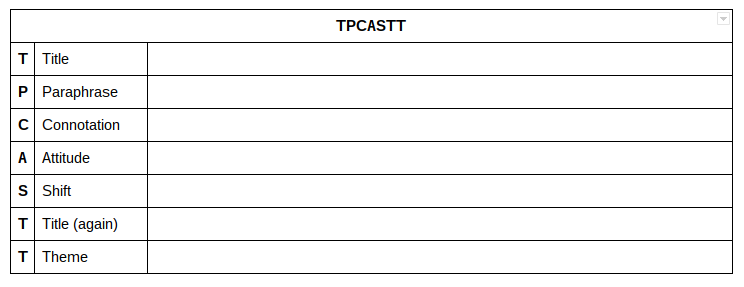
Revamping TPCASTT


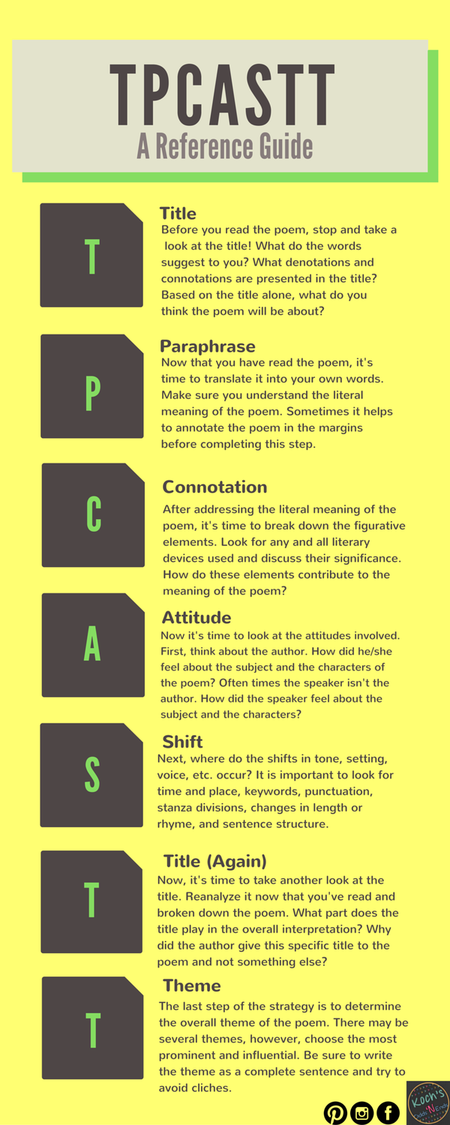
Hey there, everyone! So, because it's National Poetry Month, I thought it would be a great time to talk about how I use the TPCASTT strategy in my classroom and how that has evolved. Now, for those of you who are unfamiliar with this strategy, TPCASTT is an organized and structured way to help students analyze any kind of poetry. It has been my experience that asking students to analyze poetry without structure leads to confusion, frustration, and eventually a dislike for the activity in general. The TPCASTT strategy is the best way I have found to help students analyze poetry.

When I was in junior high and high school (and even a little in college), I was assigned poetry analysis assignments with a TPCASTT all the time. However, without directions, practice, guidance, and feedback I found myself scratching only the surface of the poems I was asked to analyze. When I became a teacher and saw that the same strategy was in my curriculum, I decided there had to be a better way to have students utilize it. I decided to give the old strategy a face lift.

Instead of just listing what each letter stands for and giving students a blank box, I decided to give more guidance and directions. As we all know, middle school students really rely on structure and very precise directions and so I kept that in mind as I tweaked this famous and frequently utilized graphic organizer. The biggest thing I decided to do was to add questions and comments that would guide students in their analysis. I also made more room for paraphrasing and broke the "Connotation" box into six smaller boxes to help students visualize the importance  and amount of literary elements in poetry.

I have found that, since doing this, my students comprehension of poetic texts have improved. I've also found that their willingness to participate in activities and assignments that come after the analysis of a poetic text because they are confident in their actual analysis. All in all, I really like this strategy for analyzing poetry in the classroom. I just think that, in the context of a middle school classroom, it needs a little extra structure and organization!

Below is a graphic I made for my classroom to help students remember what goes in each box of a TPCASTT! It's a quick reference guide that can be used by anyone! And if you're looking to use a ready-made TPCASTT organizer, instead of creating your own, head over to my TpT store! I have the above template available there!

I'll see you next month! Happy teaching!


Monday, April 18, 2016

Celebrate 500 Followers On Facebook With Us!

The ladies of the Middle School Mob are beyond humbled and touched that over 500 of you are stopping by our Facebook page and our blog for Middle School tips, tricks, inspiration, and free resources.


When we banded together, our goal was to help middle school teachers just like YOU! We want to make your lives easier by sharing tried and true teaching ideas and resources with you. We sincerely hope we've been able to do just that.

As a way to say a HUGE THANK YOU for all of your support, we got together to give away a $100 gift card to Teachers Pay Teachers. Just follow the instructions on the Rafflecopter below in order to enter to win!

*Giveaway ends Sunday (4/24) night and the winner will be announced next week on the blog.*


a Rafflecopter giveaway