Bloglovin' Facebook Pinterest E-Mail Instagram Shop Home About Us Freebies Shop Image Map
Showing posts with label Writing. Show all posts

Saturday, March 24, 2018

Let's Celebrate National Poetry Month

Spring is just around the corner -- and as April arrives, we have the perfect opportunity to share fantastic poems with our students during National Poetry Month.

I've asked a few of the Middle School Mob to share their favorite poetry resources.  Here are four great ideas for engaging your students with poetry:

A Poem that is Worthy of Missing Recess??

Caitlin and Jessica from EB Academic Camps want to share their students' love for Edgar Allan Poe's poem "Annabel Lee."

"You know it's an effective poem to teach when your students continue analyzing and talking about the content long after you have finished your lesson plans!"  They say.  "We just never thought it would be a poem from 1849 that our students would become obsessed with.  They honestly want to spend recess time with us to continue discussions, and we've even had a few students who have asked for their parents' thoughts about the poem.  Year after year, Edgar Allan Poe's "Annabel Lee" does just that!  It is the PERFECT spooky poem to use around Halloween (but we've also taught it in April during National Poetry month, so honestly, it really doesn't matter!)

Click the link below to learn more about Caitlin and Jessica teach this spooky poem:


Powerful Read Aloud

Lisa from Mrs. Spangler in the Middle  offers this great idea for introducing poetry to students.

"Love That Dog by Sharon Creech is a poem that is also a book," Lisa says.  "It's a free verse piece that gives voice to students' general aversions to poetry (it's "just" for girls, there's "nothing" to write about, poems are confusing and hard to understand, etc.) but then goes on to show that writing and reading poetry is not only enjoyable, but can also be a good way to deal with painful emotions and memories. It's a very powerful read that includes other famous poems along the way, but makes them relevant to today's middle schoolers.  It's so powerful when read aloud, and I can't recommend it enough!"

You can click the link below to read Lisa's blog post on her top 3 poetry picks:


Need Ideas?

Sharon from Classroom in the Middle  says, "One of the great things about April is the month-long celebration of all things poetry known as poetry month.  At this time of year, teachers can always use more poetry ideas and resources -- whether is it new poems to teach, fun poetry activities, or sites for kids to check out for an author study.  

Check out the links in this post for some great resources:


30 Days of Poetry

Marypat from Just Add Students loves providing students with opportunities to write their own poems.  

"Students love writing a variety of poems," she says.  "from the simple to the complex.  And when they have a mentor poem to pattern their own writing after, the entire process is less scary and intimidating. From an acrostic to an ode -- students can play with poetry forms to express themselves and practice using language in new ways!"

Click on the link below to check out her 30 Days of Poetry resource:

30 Days of Poetry


What will be happening in your classroom to celebrate National Poetry Month?
How do you share poetry with your students? 
Let us know in the comments!

Here's to a month filled with great poetry!


Friday, September 16, 2016

The Writing Process: What Students can Learn about Themselves

Student writers need to brainstorm, draft, revise, revise, revise some more, and proofread.  So how can your students keep their work organized in a way that also helps them reflect on their learning as writers?

Hello!  Marypat here from Just Add Students to introduce you to BGP.

Let's start with the problem...

I ask my students to save all graphic organizers, prewriting, drafts, and revisions for each writing assignment.  But there is usually more than one student who struggles with organization.

Papers always go missing, get stuffed into the wrong binder/folder/book/locker.  That student may end up starting a writing assignment several times -- trying to remember what had been written on the graphic organizers or in a draft.

The writing "process" was more of an exercise in starting over when students couldn't find prior work.

Then something wonderful happened...

I went to a workshop put on by my hero Nancie Atwell.  I am telling you - she is nothing short of amazing.  I learned so much from that workshop!  Here is one idea I used with great success. Something that helped all of my student writers, not just the disorganized ones.


Grab your stapler...

I had my students save, and staple, all of their work on a writing assignment together.  Most current work on top.  This was what my students referred to as the "big, gigantic pile."   The BGP.

As my students write, I collect and review all of the steps of a draft (that's how I sort and set up mini lessons for the next day).  As we work through graphic organizers, intro paragraphs, thesis builders, drafts (D1, D2), revision activities, peer reviews, proofreading and then finally the published piece, the "big, gigantic pile" grows.  Always with the most current work stapled on top.

What the student ends up with is a "big, gigantic pile" of work stapled, marked up, and dog-eared.  On the very top, they add their published piece (usually not stapled so it can easily go into their portfolio or on the wall).

And the result...

Several really great things happened when I started implementing the BGP:

1.  Work was less likely to get lost.  All the pages were kept together and kept in writing folders. 

2.  Students were impressed at how much writing they had done!  I heard students say things like, "Wow, I did a lot of work on this!" and "Look at how bad my first draft is!"  and "My ideas really changed as I worked on this!"  

Students were thinking about, reflecting on, and rejoicing in their writing!  They could see that their writing was, indeed, a process.  (Insert happy dance here!!)

3.  Student self-assessments.  Before my students turn in an assignment, I always ask that they complete a simple self-assessment.  It consists of three questions:  
  • What was easy about this assignment?
  • What was difficult about this assignment?
  • What would you like me to know?
I ask students to flip through their stapled pile and consider what they've been working on, thinking about, struggling and succeeding with over the last few weeks.  This gives them a chance to really consider how the writing process worked for them.  Plus, it helps build goodwill that they know I care about their experience with this writing assignment.

4.  My grading got easier.  Yes.  You read that right.  Easier.  Because I reviewed each graphic organizer, thesis, intro, and draft as we worked on it, I knew what students were writing about.  I could quickly see where they were going off the tracks.  My comments gave them direction for the following writers' workshop task.

When I received the final product to assess, I could look through their "big, gigantic piles" already familiar with the topics, direction, and difficulties they had.  I could see where students worked on my suggestions and where they chose to ignore those suggestions (time for a conference!).

Usually, I had very little to write on the published text.  I'd already addressed issues in the prior drafts.  And because I always use a rubric and the students received that when the assignment was given, I could quickly assess their writing on the criteria of the rubric.

I love trees...

I do, I really do!  And I often think about how wonderful a paperless classroom would be.  However, when teaching middle school students writing, there is a HUGE payoff when they can actually see the writing process.  Specifically their own writing process from start to finish.

When I experimented with paperless writing, my students lost the ability to step back and look at their own writing process -- from where they started to where they ended up.  

Even if you give the BGP a try for one assignment, your students will benefit.  It can be used for any writing project -- in any subject.  But most importantly, it will help your students think about themselves as true writers.


Wednesday, April 20, 2016

Poems for Assessment

Middle School students are often the most emotional, imaginative, and creative kids around.  They are struggling with all of the new life experiences that surround them, and more importantly, they are searching for a way to let it all out.  For some, writing poetry can be that release!


Poetry writing has long been an incredible form of therapy for the soul, but in our classrooms, it can also be a form of assessment.  With so many options for how to write poetry, it can be done in very effective ways to demonstrate student understanding or to show student processing of content or a subject-area concept.

H
ere are a few suggestions for using poetry in your class for assessment:
  • When studying significant people, whether dead of alive, students can create fact filled Epitaphs or Biographical Poems.  Provide a template or allow students to research the purpose of each prior to writing, and set requirements to meet the standards of your course.
  • Examine important events or subjects by using Haikus. This Japanese art form has long helped people connect their thoughts to events, and students can use this short format for writing concise summaries.
  • Another great tool for examining time periods, unit topics, or themes is the Acrostic Poem.  This easy to use template format can help students detail their topics while processing and extending information into a cohesive flow.
  • For the very creative, encourage the creation of a Shaped Poem, allowing art and knowledge to meet for an assessment like no other!
Whether you utilize templates or allow your students to free verse their way to your heart, the opportunity to write poetry for assessment may open doors for some students who have had challenges with writing in the past.  More importantly, it may be the encouragement some need to inspire them to learn and participate more in your class!

Happy Teaching!

Friday, March 25, 2016

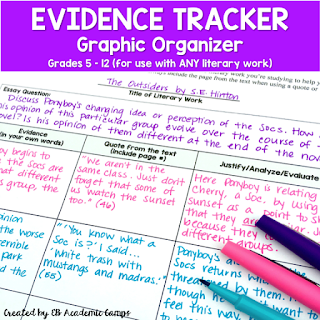
Evidence Tracker for Reading Comprehension & Argumentative Writing

Hi Everyone!

Caitlin here from EB Academic Camps and The Styled Teacher where I blog about teacher fashion. I won't take up too much of your time today because I'm sure you're either thoroughly enjoying your Spring Break, or you're thisssss close to freedom for a week or so :)

I have to be honest. I never had to do test prep in my classroom. There were never any state tests.* No tests that dictated the future of my students. My future. My school's future.

I had none of it. And it was awesome. 

So, with that being said, today I simply want to share a really awesome resource with you that will be a HUGE help for your students in your classroom.

One of my biggest areas of focus when I was teaching was in evidence-based, argumentative writing. To help students keep track of evidence while reading a chapter, studying a poem, or throughout the course of an entire novel, I had them keep track of evidence that would later help to support their claim or thesis for the essential question. (If you want to learn more about creating your own essential questions and how to do it, ----> click here.)

And this resource helped us do just that! 

How to teach students to use the text to provide evidence to support their claims. A great argumentative writing idea!

We also recently created this resource in a DIGITAL version, so you can use it over and over again in your paperless classroom!


Please let me know if you use it in your classroom and if your students find it helpful!

Thanks again for stopping by for all things Middle School :)


*I taught at a private school and apparently we just kind of do whatever we want ;) In all seriousness though, we did have yearly and quarterly tests our students took as benchmarks to help us direct our instruction, but nothing that weighed as heavily on our shoulders as I see currently for all of my public school teacher friends :/

Sunday, November 29, 2015

12 Days of Christmas Activities (FREEBIE ACTIVITY)

Happy Holidays Everyone!

We hope all you USAers (is that a word?) had a fantastic Thanksgiving holiday with family and friends! We are officially into the Christmas and Holiday season, and it is oh so exciting!

Celebrating the holidays was one of my favorite parts about being a teacher. I've always taught in Catholic schools, so Christmas was a huge deal to say the least. I used to decorate my classroom with Christmas lights, play Christmas music all day long, decorate with student Christmas work everywhere. You get the idea ... I stinking love Christmas.

This year, Jessica and I created an awesome 12 Days of Christmas Activities unit that can be used in conjunction with any unit of study! Since you are all awesome Middle School Mob junkies, I want to direct you to an EXCLUSIVE FREEBIE that is not featured in our TpT Store. You can only access it by CLICKING HERE!

Here are some awesome pictures of the complete unit. How cute are these activities for students, which you can then use as decorations for your classroom? It's a win-win if you ask us!


Wishing you all a joyous Holiday Season!


Monday, November 16, 2015

Thanksgiving Thank You Notes (FREEBIE)

It's Caitlin here from Teach Inspire Change

One thing that I personally love to do is write thank you notes. Generally, when I send someone a thank you note, they are shocked, which says to me that thank you notes are going out of style. And they absolutely should not be. There's something truly special about sitting down and expressing your gratitude to someone through a written note. So with Thanksgiving just around the corner, we put together a super helpful resource for you to write thank you notes in your classroom. If I were still in the classroom, I would certainly spend an entire class period working on thank you notes - you could even make your own thank you notes if you're the extra creative, scrapbook-y type!


I really hope you enjoy using this freebie with your students. Happy Thanksgiving to you all - you're almost there :)


P.S. If you're at a loss for a short and challenging unit to teach before the Thanksgiving holiday or even before the Christmas holiday, our "The Gift of the Magi" unit is an excellent resource!

Friday, October 23, 2015

NaNoWriMo in the Classroom

Hi all!

It’s Stephanie from The Marvelous Middle and I am here to share something MARVELOUS going on in my classroom. NaNoWriMo is about ready to happen and for the first time, I’m asking my young authoring students to come along for the ride. November is National Novel Writing Month, which pushes people to write a novel (50,000 minimum word count) during that month. They also have a Young Writers Program that allows students to set their own word count goals and complete their own novels. So this year, the stars have aligned and I have been able to put in the extra time to get this program going with my students.A whole novel you ask? Yes and they looked at me as I’m sure you are looking at the screen right now! After the shock wore off a bit, I explained that they were in total control of their writing destiny and we would be our own community of writers. So with November on the horizon, we began preparing today. We discussed what makes a “good” book and what makes a “bad” book. We talked about how it’s important as authors to understand that our novel must have some characteristics that appeal to readers. I asked the students to share with me their own opinions of qualities of “good” and “bad” books. Below are a few of their responses:

“A good book in my opinion is one that is fast moving. The book has to flow swiftly and smoothly. It needs action, lots of action. I want to see the story in my head. I love mythology books with Cyclopes, centaurs, gods, demi-gods, dragons, etc. I need the book to have interesting battles and a very strong climax. I need the book to hook me almost from the beginning, not half way through the story.”
Poetry seems unimportant and unorganized in my mind, so it does not interest me.  Most people find poetry interesting and exciting, but everyone is entitled to their own opinion.”
“A book that has no conflict is a book I am NOT reading.”
“To me a bad book, is a book that tries to please everybody by taking the newest thing and making a book about it.”
“A good book should make me shove my face in it and never stop reading it!”
“Science fiction books appeal to me because the things that happen aren’t in everyday life, you just can’t walk out your front door and sun flares hit the Earth.”
“I think it’s a great way of writing always leaving your reader on the edge of their seat, making them want to keep reading and reading on. When I say that they should leave you in suspense that doesn’t mean that they should stop the chapter in the middle of a sentence, it means that say a girl gets kidnaped and the cops are about to go to the scene and they make a wrong turn per say that’s where the chapter would end in my opinion. You want to know what’s going to happen now that they are not on the right track.”
Next week, we will start to look at what makes a character interesting and seeing that strong characters move the story along. Then beginning on plot structure by the end of the week. We will be ready to start writing our literary masterpieces November 2.I am most looking forward to my students realizing that authors don’t typically just throw a novel together and need to go through a process. My students struggle with revision, regardless of how many times we have talked about its importance. I’m hoping that writing a novel and seeing that revision is critical will begin to open their eyes to more than just getting words down on paper. And it still remains a good lesson for me, too. I will be taking my own NaNoWriMo challenge of writing a 50,000 word novel in November.  If you would like to join me, information can be found at www.nanowrimo.org.Follow our young authors through the process on my blog, The Marvelous MiddleIf you would like more information about NaNoWriMo Young Writers Program, go to http://ywp.nanowrimo.org.


Wednesday, October 21, 2015

Introductory Paragraph Writing

Hey everyone!

Wanted to share a quick overview of how we teach introductory paragraph writing in our classrooms (we've taught 4th grade, up to 12th grade, and all levels in between). This overview should be helpful for whatever grade you are currently making a difference in :)

The basic outline of an introductory paragraph is as follows: TAG (title, author, genre), Summary, and Claim (or Thesis).


TAG
This is the first sentence of the introductory paragraph and it should always include the Title, the Author, and the Genre (in whatever order the students choose). It's really important to include at TAG at or near the beginning of your paper, so your reader knows what you're writing about!

SUMMARY
The summary is the next 2-3 (maybe 4) sentences of the intro paragraph and it should summarize the text students will be writing about.

CLAIM
The claim is the LAST sentence of the introductory paragraph and should state the student's basic answer to the question from the prompt or whatever it is that they are trying to prove.

It all seems pretty easy in theory, but when put in to practice it can be a nightmare. I swear, I would have some students at the end of the year who would put their claim in the first sentence. It is what it is I guess!

We created a neat graphic organizer for you that you can download for FREE by clicking here. Also, feel free to stop by our TPT store if you're looking for a great Halloween FREEBIE or an entire Poe Halloween Unit (which is currently 50% off!) to use next week leading up to Halloween!


Tuesday, October 20, 2015

Basic Paragraph Structure (A Systematic Introduction to Embedding Quotes)


Hey there, everyone! It's Taliena from Koch's Odds 'N Ends and I'm here to share with you how I introduce students to embedding quotes. I don't know about you, but the curriculum I teach asks my students to not only embed quotes into their writing but to be doing so flawlessly for our big research paper that we do in December. I'm tasked with the overwhelming responsibility to teach them this skill from the ground up. I have found that the easiest way to do this is to first teach it as a systematic formula.

I usually begin by having my students paste the notes handout below into their notebooks to use as a reference as we practice.
This notes handout is a freebie on my TeacherspayTeachers store!

Topic Sentence- the main idea of the paragraph (I like to point out to students that this isn't new. A topic sentence is still a topic sentence)
Evidence- specific examples (proof) from the text that help develop the main idea from the topic sentence
Commentary- sentences that explain and develop the ideas from the evidence and main idea (I like to use sports commentators as a way to help explain what commentary is. I ask what a commentator does and draw similarities to help define this new word)
Concluding Sentence- the very last sentence of the paragraph that should be thought-provoking and should summarize the main points of the article (once again, I like to point out that this idea isn't new. A concluding sentence is still a concluding sentence)

When teaching a brand new topic, I like to demonstrate first, practice together as a class second, and then have students practice individually last (I do, We do, You do Method). Thusly, I choose three non fiction articles from my favorite non-fiction article website (NewsELA). With the first article, a fairly simple prompt, and the notes handout mentioned earlier, I write an example paragraph using the T.E.C.C. formula. I show this article after going over the notes handout to show examples of what each box's content should look like. Next, and with the second article, I write a paragraph with my class using the formula they have seen twice now (once in their notes and again in my example paragraph). And, with the third article, I have students practice the formula on their own.

Now, I don't usually teach writing in such a formulaic way, but because this is the first time most of my students have even heard the term "embedded quotes", let alone attempted to effectively use them, I have found that this is a great foundation or jumping off point. Middle school students crave that structure as a reassuring "pat on the back" that lets them know they are completing this new task correctly. I would love to hear your thoughts on this. Let me know if you've tried this method or something else!

See you next month,