Hi, everyone! Mandy from Caffeine and Lesson Plans here to talk to you about writing in mathematics. It's something that has been on my mind a lot lately, as my district has designated writing as the focus of our instruction for this school year. So many teachers automatically began to focus on narrative writing, but I thought I'd apply it to my teaching in other ways, too- namely, in mathematics!
I have to tell you, math has a special place in my heart. In addition to my generalist teaching license, I hold a math specialist license. I think that people tend to give themselves permission to be afraid of math in a way that they do not in other subjects. I've heard parents dismiss a student's bad grade by saying "oh, well, I was never good at math either. Maybe he doesn't have a math brain" I've never heard a parent say the same about another subject though. No one dismisses poor reading with "well, maybe he doesn't having a reading brain." All the parents I have worked with have done everything possible to help their child overcome their reading difficulties, and when all else fails they have had them tested for learning disabilities. So, why the difference in math? I think it all comes down to how students are taught. Allowing students to apply the academic skills that they are good at and enjoy using will help them to deepen their mathematical knowledge. Sounds easier than it is, right? I totally agree- and there are a million ways to incorporate literacy and mathematics! They don't all work for the middle grades, either. So- here are my quick tips.
Math Literature
Invest in some quality mathematical literature. It's expensive, but there are ways to get some reasonably priced books. I visit my local used bookstore, go to library book sales, and hit up yard sales. I also order them from half.com and check the used prices on amazon.com. When all else fails, I use my scholastic book points to order them. My math library is well stocked- I have something for everyone! I have created task cards to go with each math literature book, and have my students read them during one station of guided math. It's a win for everyone. My students that are avid readers can't wait for the opportunity to read some more, and my struggling readers get the opportunity to practice their reading some more. More than that, teaching mathematics through literature makes a stronger connection to the material. The students see it is a something that is learned organically, much like the morals or lessons that they learn from other stories that they read.
Creative Writing
I mentioned earlier that my focus on writing this year has tied into my mathematics instruction. So far, it has really worked. Each morning as my "do now" activity I give my students an equation that relates to what we learned the previous day. Their job is to write the story of the problem. They write a word problem that ranges between a few sentences and a paragraph. I have seen some seriously creative writing come out of this! More than that, their stories have given me some really good insight into their mathematical understanding. Do they know the key words that indicate operations? Do they correctly describe which operation to use within their story? Do they understand how to indicate what each number represents? I feel as though I have been able to learn more about what the students actually understand by reading their stories than by checking their computations on word problems I provided.
Expository Writing
Some of my students really need to talk about their learning to help build permanent knowledge. Usually, this isn't a problem in my classroom as we work in small groups and talk frequently throughout the lesson. Sometimes, though, we just don't have enough time to talk as much as I would like. So, I ask my students to "talk it out" in writing like they would with a partner. I often have them write a letter to another student explaining how a particular mathematical concept works- for instance, how to create equivalent fractions. I always ask them to pretend the person they are writing to has no mathematical knowledge so they explain everything. The act of putting the words on paper makes deep connections that some students need.
So, that's it- how I incorporate literacy and mathematics instruction in my classroom. I'd love to hear what's worked for you, too!
Monday, October 12, 2015
Friday, October 9, 2015
Tips for Teaching Realistic Fiction
Shana from Hello, Teacher Lady here.
My 7th graders are currently in the midst of one of my favorite units, Realistic Fiction. It's so much fun to see their creative sides and I'm always impressed with the ideas they come up with. So for today's post, I'd like to share with you some things I've learned about teaching this wonderful genre!
- Define the genre: This sounds like a no-brainer, but in the past I've jumped right into the unit without clearly defining and consistently reinforcing what realistic fiction is... and what it isn't! As a result I've had students come up with some brilliant story ideas, only they fit into other genres such as science fiction or fantasy. Now I make sure to provide students with plenty of mentor texts to serve as examples and we talk about realistic fiction elements on a daily basis. I might sound like a broken record sometimes, but I don't have to crush as many students' dreams about robot rebellions or magic kingdoms.
- Brainstorm, plan, share and repeat: It's important to give students plenty of time to brainstorm, plan and share their ideas with others. We spend about a week in the brainstorming and planning stages before students even begin to draft their scenes. They need to have a firm grasp on who their character is and what their conflict/resolution might be, so we spend a couple days solely focused on discovering their characters' motivations and struggles, and a couple days solely on brainstorming potential internal and external conflicts.
- Write with them: One of my favorite parts about this unit is actually writing my own realistic fiction story too! I always try to model the thinking process during the brainstorming phase or demonstrate anything that I’m asking my students to do, so writing my own story just sort of naturally happens over the course of the unit. I think it’s beneficial for students to see this progression, and they always have fun brainstorming ideas with me!
- Collect graphic organizers and exit slips. My district follows the Workshop model, so they have a lot of class time to brainstorm and plan while I circle the room (in an attempt) to "confer" with every student. This is an area of workshop I admittedly still struggle with, as I find it difficult to touch base in a meaningful way with every student. While I’ve always given them graphic organizers to complete before they begin drafting, and I’ve attempted to read through them during our mini-conferences, the fact is there’s just not enough class time for this! To help save time, I started collecting students’ graphic organizers and making comments at home, then using my comments to help guide my conferences during class. This really helps me see if students are on the right track before they get too far in the writing process, and I'm able to identify common problems and can pull certain students for "strategy groups" if I notice a pattern. It’s a little more work at home, but it saves tons of class time and makes conferring so much easier and more efficient! For exit slips, sticky notes are a great tool, and you can display them in your room as visual proof of your students’ thinking and progress!
- Set a page limit! This one is for your own sanity. I tell my students they have to tell their stories in 5 pages or less. If you don't set a page limit, you'll end up getting some reeeeallly long stories...
Thanks for stopping by the blog today! I hope you found this helpful! :)

Thursday, October 8, 2015
How I Help Struggling Writers
If you have students with special needs in your general education class or just have some students who are slow learners that struggle with writing, then this post is for you!
I have been teaching ELA and SPED at the middle school level for nearly 22 years. It has been my experience that to reach the students that struggle and have those moments where the light bulb comes on with writing is to embrace patterns.
Let me show you what I mean:
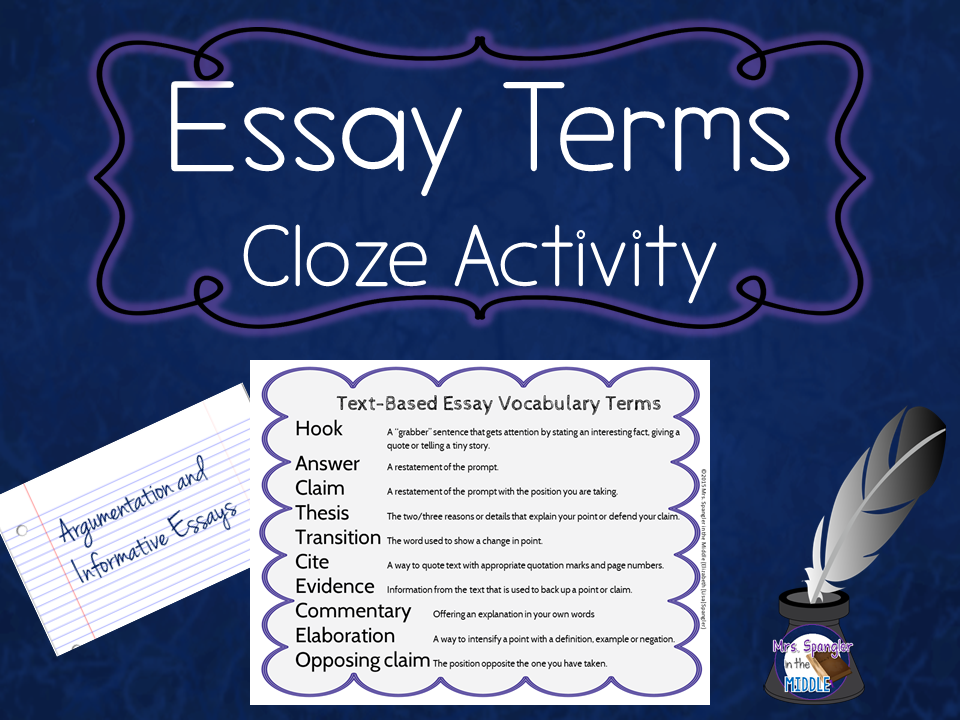
These are my text-based essay anchor charts that I have used with both "regular" and special needs students. These anchor charts provide a pattern for students to follow along with a memorable mnemonic.
HAT is for the introduction - a hat goes on top of your head and likewise goes on "top" of the essay. ACE IT is a good way to remember what goes in the body of an informative essay and ARGUE matches argumentative. Then what's the last thing you grab before your leave home? Your cell phone - your AT & T! Ok, I know not everyone has AT & T but work with me here! :)
Now keep in mind that this is just a foundation. I am not suggesting that these structures completely define an essay. Certainly as the students learn more and progress, so will their writing.
However, for students who are really struggling, this gives them a lifeline. I have found that most students "get" the concept of an essay and maybe even know some of the basic vocabulary, but they lack an understanding of how to apply what they know. It all seems theoretical without a pattern to follow. It's like me understanding that I need to go north to reach my grandmother's house but not being able to get there without a map.
So first we go over all the vocabulary. There are so many ways to do this but one of my favorites is using Quizlet. This is a free site and app where you input the words and definitions and then the program places your information into various games. Then, when you're ready to assess, you can use my free
Next, I take the students through the entire process of essay writing:
-reading the prompt
-understanding what they are reading to find out
-reading the texts one at a time & then mapping them one at a time
-planning the essay according to the pattern with a graphic organizer
-modeling each paragraph type with a foldable
Yes, this takes time (about 7 days or so), but it is so totally worth it when you see your students go into the tests with a plan and then watch them implement that plan on their planning sheets! That means no more blank planning sheets!! Can I get a Hallelujah?! That's what I was shouting inside my head last year when I saw this happen with my own eyes for both my "regular" and special needs students.
If you'd like more information on how to implement the step-by-step Informative Essay or Argumentative Essay, please click on those titles.
Want to share your experiences with struggling writers?
Join in the conversation in the comments below!
Labels:
text-based essays,
Writing
Wednesday, October 7, 2015
Use "Notes From Your Teacher" to Simplify Grading Papers
It's a Sunday afternoon. The air is crisp. Bright red and orange leaves decorate the lawn and trees. The sky is crystal blue...and I am sitting at my kitchen table facing down a stack of student essays.
Don't get me wrong! I love to teach writing. I love to see the progress my students make as they work through ideas, logic, drafts, and reviews. And I firmly believe that the best way for students to improve their writing is to write -- a lot.
Students need practice and feedback.
It's the feedback part that gets me. I often say I need to install a seat belt on my chair to keep me in it until the stack is gone. However, I'm willing to stay in my chair weekend in and weekend out in order to get my students to write -- a lot.
I use writing workshop, and this provides a lot of flexibility. But I feel like I am writing the same comments over and over again on papers. My solution is to differentiate student tasks during our workshop time by using "teacher notes."
So here is what I do to reduce my grading time, but also give my students feedback and purpose for their time during writing workshop:
1. I read through the student drafts. I always review graphic organizers, idea sheets, and prewriting. This allows me to catch students who are running off the rails. There is nothing worse than reading a draft or (worse yet) a final essay and realize the student didn't follow the directions. I generally collect student graphic organizers or idea sheets as the students walk out of the room. This is their "ticket out." I can quickly sort through the papers to see who is ready to move on and who might be stuck.
A colleague of mine uses a red dot on papers that aren't ready to go forward and a green dot on papers that are. If you have a red dot on your paper, you need to meet with the teacher before moving on. Brilliant.
2. I print up the "Notes from your Teacher" document for the mode of writing I'm using. As I'm reading a draft, I can quickly check off the items I want the student to work on.
There is space at the bottom and room on the back for me to write notes if I feel the student needs more. There is also a space for "see me" if I want to have a conference with the student.
As I'm reviewing papers, I stack them in groups. Students who are ready to move on go in one group. Students who need to work on similar issues (a thesis statement for example), go in another group.
The next day in our writing workshop, I can meet with groups of students, review what their next steps are, and set them to work. All of my students are focused on their task for the day.
3. Mini lesson magic. The "teacher notes" also help me determine what my mini lesson for the next day will be. I know my lesson will address my students' needs.
4. As students work during our workshop time, they respond on the right side of the "teacher notes" sheet. My favorite part is the little cartoon at the bottom. It gives me instant feedback on how the student feels about the writing done that day.
At the end of class, the "ticket out" is the writing and feedback on what the student completed that day and how he or she feels.
So even if I don't get to conference with each student during our workshop time, I get feedback from them.
5. And the cycle continues.
6. I have my students keep ALL of their graphic organizers, idea sheets, drafts, and teacher notes. They just staple the most current work on the top.
This is the best thing for students. They can really see how much work writing requires. They look at their stack and see their little "seed" of an idea grow into a real narrative or an argument. They can look through drafts and point to where they revised weak sentences or used vivid details or provided supporting evidence when there was none there before!
7. Okay, so back to Sunday afternoon. It's crisp. There are leaves. And I still have time to play in them with my dog. Partly because I read my students' writing every day. Partly because I use a checklist feedback form like my "teacher notes." And partly because I installed a seat belt on the chair at my kitchen table.
Write on, my friends,
Ps: If you want to try out the teacher notes I use, I'm offering them for FREE for the next 24 hours. Jump on over to my store and snag 'em. Just Add Students. Be sure to let me know how they work for you...and I'd be remiss not to ask you to be my bff and follow my store (okay, you've read this far in the post...surely you want to follow me??!!). Happy writing!! mp
Labels:
teaching,
Teaching Organization,
Writing
Tuesday, October 6, 2015
Writing in Math
Hello, everyone! Mylie here from Edison Education to talk to you today about writing in math.
Wait, what? Writing in MATH??!!
Yes. You read that correctly. Writing is critical in all academic areas. If students can write about math, then they have a deeper understanding of all of the "whys" that go into it. It is hard for students to get involved in math because they truly do not understand why they will ever need to know the information. My goal this school year was to change that.
From my desire to implement writing in math class, I set about trying to create a way to get my students involved in writing. Did you know that there are virtually nothing about writing in math online? I mean, there are a few topics, but not anything of substance. And definitely not any prompts that I could use. It eventually evolved into creating my Writing in Math set on teachers pay teachers.
In my classroom, we start off our week by doing a writing as the warm-up on Mondays. I require my students to be able to complete the writing assignment in 4-5 sentences. My goal is to increase the number of required sentences each six weeks as the school year continues.
I will be the first to admit, I was fully expecting to have some push back from my students about writing with math topics. However, my students greatly surprised me. They embraced the weekly writings with barely a hiccup. Not only are my students getting to practice their writing skills, but I have also gotten to learn how my students truly view math. There have been some surprising revelations when reading their writings. I feel I have gotten to know my students even better than I did before.
If you are thinking about implementing writing in math class but do not know where to start, my Writing in Math set will be a great way for you to start. They are ready-to-print with no tweaking needed. I will be using them myself as the school year continues!
Have you ever implemented a consistent writing in a non-ELAR class?
Monday, October 5, 2015
WebQuests and Writing in the History Classroom
Hi everyone! Julia from History from the Middle here! I wanted to share with you all how I incorporate elements of writing in my history class through the use of highly engaging WebQuest activities!
There are so many different ways for content areas to incorporate writing, and make it meaningful and engaging. With the implementation of Common Core, students now, more than ever, must use evidence-based support within their writing. This is such a natural element for history to incorporate, because most of what we write has to be based on historical evidence!
One of the ways that I do this, and my student's LOVE it, are through research-based WebQuest activities! Depending on the topic, students may have to read a primary source to gain evidence, watch a video, examine an artifact....The possibilities are endless!
To show you what my student's do, I'm going to walk you through one of my student's FAVORITE WebQuest activities which is a CSI Investigation of Otzi the Iceman that I do with my Ancient Civilization students when we are in our Early Man unit.
Students start the activity by watching an introductory video on who Otzi was, and where he lived. This helps to build the "suspense" of the investigation! Next, students go through different pieces of research to help come to their own conclusions on what happened to Otzi and determine how he died.
For this activity, I created a Google Site and loaded all of the directions for the investigation step by step.
Students then work with a fellow investigator and go through a series of research questions to help build their background knowledge on what may have happened to Otzi.
Once students have researched the background information, and the possible 4 theories as to what happened to Otzi, they are then to write their final investigative report!
I am in a 1:1 school that uses GAFE (Google Apps for Education). I personally run all of my assignments through Google Classroom (which I will do a separate post on!)
I then go into Google Drive and create a Google Doc for students to write their final investigative report. I then take that Doc and load it as an assignment in Google Classroom.
One of the great benefits I like about having students work in Google Docs, is the collaboration piece. While they are working, I'm able to go into their document and watch what they are doing, and make comments and give immediate feedback!
One of the things I love about using WebQuests to invoke the writing process is the natural flow of writing that occurs. Students become so engaged in the topic and the process, that the writing just comes so naturally! To see them using the evidence from the research in their writing is so EXCITING!
From my experience, having students interact with the content in a way that evokes certain feelings/opinions/emotions allows them to access the writing process in a different way. Even though I teach history, we are all still reading and writing teachers and we need to provide as many opportunities for our students to implement those standards outside of their language arts class. I think that WebQuests are one of many ways to do that and get students excited about writing!
What are some interesting methods you use in your class to get students excited about writing?
Thursday, October 1, 2015
Quick and Fun Strategy for Summarizing!
Hi everyone!
Today I wanted to share with you a quick and easy strategy that is also a FREEBIE! in my store right now, so check it out!
My 7th graders are studying plot in their reading class, along with subjects and verbs in their writing class, so this was a great way to tackle two birds with one stone! They read the story "The Interlopers", and had already filled out a plot chart on the story, along with guided reading. This activity allowed them to prove their knowledge of the plot, along with their ability to summarize, and then tested them on their knowledge of subject and verb all in one activity!
We did the handout on day one, and students "published" their work on day two. This reinforced their knowledge of the setting, as they had to illustrate their finished two word story with an image that represented the setting. Then they mounted their masterpieces on construction paper so we could display them in the hallway. Quick and easy strategy, and the students had fun reading what everyone came up with. I hope your students have as much fun as mine did with this!
Subscribe to:
Posts (Atom)